Ordinary Indian Men · The story behind the movement
An Ordinary
Indian Man.
When was he allowed to be human?
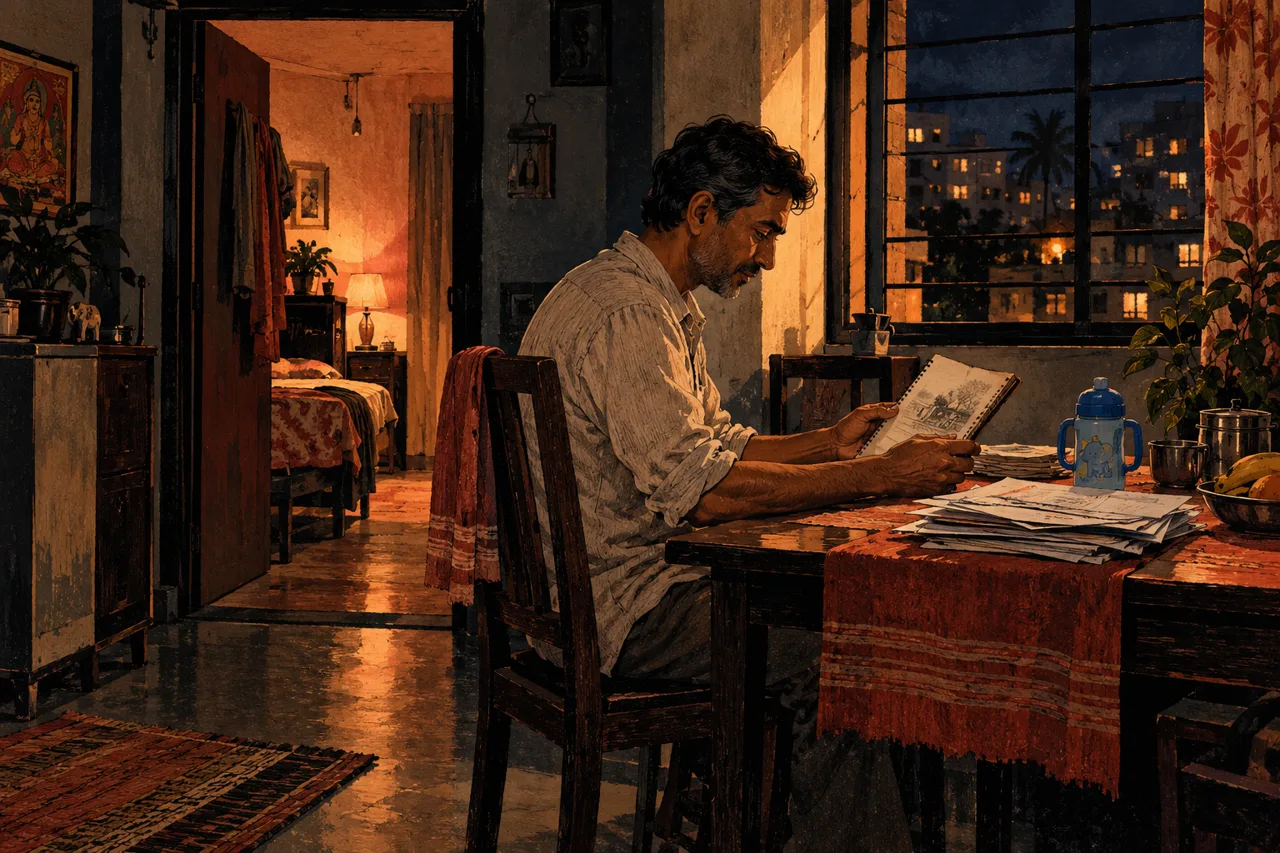
Meet Amit. A boy. A son. A worker. A husband. A father.
One person beneath every responsibility.
15 minute read · Fictional composite · Illustrated story
The training
The boy nobody listened to
Amit was eight when an aunt crossed his bodily boundaries in front of relatives. He tried to move away. She caught his arm. “What’s wrong? We’re only playing.” Everyone was looking. He wanted to disappear.
Later, he told his mother that he did not like what had happened. She was folding clothes. “She’s your aunt. She loves you. Don’t make a fuss.” That was the end of the conversation. Except it wasn’t the end for Amit.
The next time the family visited, he avoided that room. When his aunt called, he pretended not to hear. His relatives said he had become rude. Nobody asked why.
Years later, he would understand that an adult had crossed a child’s boundaries and the people he trusted had failed to take him seriously. As a child, he only knew that making adults uncomfortable seemed worse than admitting he was uncomfortable himself.
He stopped telling people when something made him uncomfortable. He became quieter. Everyone said he was growing up.
A boy could say no and still not be heard.
The boy who had to be strong
Amit was thin, short for his age, good at mathematics, and fond of drawing. A group of older boys discovered he was easy to intimidate. They took his lunch, pushed him around, and once locked him inside a toilet for most of the lunch break.
He complained to a teacher. “Why don’t you stand up for yourself?” The following week, one of the boys hit him. Amit hit back. Both were punished.
His father wanted him to survive. “You have to be strong. The world won’t protect you.” But why was it Amit’s responsibility to become strong enough to stop abuse, rather than the adults’ responsibility to stop it?
By thirteen, he had learned three rules: handle it yourself; complaining may get you blamed; crying may cost you respect. The adults called this maturity.
He was being trained to survive injustice without expecting anyone to correct it.
The price of being a good son

Amit wanted to study design. He loved drawing buildings and making things. His father wanted engineering. His mother agreed. Everyone said it was safer.
When Amit tried to explain, his father showed him the household expenses. A housing loan. His grandmother’s medicines. His sister’s education. Retirement approaching. “We aren’t rich people, Amit. You have to think about the family.”
Amit chose engineering. He told his friends it was his decision. Nobody physically forced him. He simply knew that saying no would disappoint people who had sacrificed for him.
Everyone praised him. “Such a responsible boy.” The praise made his sacrifice feel valuable. He began confusing obedience with goodness.
The more he surrendered his own choices, the more people admired his character.
The young man who could not say no
College was supposed to be freedom. For Amit, it was another test. His parents had borrowed for his education. Every rupee had a purpose.
Seniors treated him like free labour. Buy cigarettes. Bring food. Finish an assignment. Pay for someone’s birthday. Sometimes it crossed into ragging and humiliation.
He knew complaint mechanisms existed. He also knew the seniors lived in the same hostel. They knew his room and his classmates. They could make ordinary life difficult. He could not afford to leave college.
A classmate asked why he tolerated it. Amit answered with a sentence he had heard at home all his life: “What else can I do?”
The circumstances would change. The question would not.
The provider
His first salary
₹18,500. That was Amit’s first monthly salary. He kept ₹3,500. The rest went home. His father was proud. His mother cried. For the first time, people introduced him as a working man. A responsible man.
Then the responsibilities grew. An emergency. A family wedding. A refrigerator. A medical bill. A loan repayment. He said yes whenever he could. When he couldn’t, someone reminded him how much his parents had done for him.
Nobody needed to threaten him. Guilt worked better. By twenty-seven, his income had increased. So had the number of people depending on it. He postponed a motorcycle, skipped holidays, and saved nothing for retirement.
One day he realised he had been earning for years without deciding what portion belonged to his own future. His income was treated as a family resource. His personal needs were optional. They called him dependable.
The expectation was not that he should help. It was that his help should have no limit.
The employee afraid to complain
Amit arrived early, stayed late, and answered calls on holidays. If he worked harder than everyone else, he thought, nobody could question his value.
A senior female manager began making personal comments, asking about his private life, and touching him without permission. After an office gathering, she made an unwanted sexual advance. He pulled away. She laughed. “Don’t act so innocent.”
He considered complaining. A colleague laughed: “Bro, you’re lucky.” Another warned that making trouble with a senior manager could damage his career.
He looked at his loan, his parents’ bills, and his empty savings. He considered HR under the general conduct policy. Then he dropped the idea. The manager eventually transferred. He told himself the problem had ended.
It was not that no possible route existed. It was that the route was unclear, and the cost of using it felt too high. His childhood had already taught him what could happen when he complained.
A complaint mechanism means little to a worker who believes using it may destroy his livelihood.
Behind the storyThe workplace protection gapThe perfect Indian wedding
Amit married Kavya. She was educated, intelligent, and confident. He liked her. He wanted a home of his own and someone who cared about him beyond his salary.
Five hundred guests. Lights. Flowers. Music. A photographer telling everyone to smile. His father borrowed for some of the expenses. Amit used most of his savings. Nobody considered this unusual.
He promised support, respect, loyalty, and a family. He meant every word. He had heard of divorce, maintenance, and dowry laws. But he assumed they belonged to other people’s problems.
He was a decent man. He would not demand dowry or deliberately hurt his wife. Surely that was enough.
He thought being a good husband was his protection against a bad marriage.
When love became an obligation
The first two years were mostly happy. They travelled, bought furniture, and planned for children. Then disagreements appeared. Where to live. Money. Housework. Both families’ expectations.
Amit was not blameless. He sometimes became dismissive. He assumed earning most of the money gave him more authority over financial decisions. He did not always notice Kavya’s work at home. When he recognised these problems, he tried to change.
But some arguments became personal. He was mocked for not earning enough. Once, Kavya slapped him. She apologised. He forgave her. Then it happened again. Another time, she threatened public humiliation if he involved their families.
He wanted help naming what was happening. He looked for protection. He imagined reporting the violence and being laughed at. Perhaps someone would have taken him seriously. He never found out.
He was ashamed because he believed a man should be able to control his own home. His childhood had taught him silence. His workplace reinforced it.
He had become more afraid of being laughed at than of being hurt again.
Behind the storyDomestic violence: who the special law protectsThe father

Aarav. Small and warm in a hospital room, his fingers wrapped around Amit’s thumb. For a few minutes, Amit forgot about work, money, and arguments.
He wanted to give his son what he had not received. Safety. Permission to cry. Permission to say no. The knowledge that his body belonged to him.
Amit opened a savings account, planned school fees, and bought toys. He changed nappies, prepared food, and stayed awake when Aarav was ill. He came home early when he could.
Aarav called him Papa. Amit had been called son, student, employee, husband, and provider. Papa felt different.
For once, being needed did not feel like being used.
The cost
The complaint
One Monday, HR called Amit in. A female colleague had accused him of sexual harassment. The complaint described an incident he knew had never happened.
He wanted a fair investigation. He produced messages, attendance records, and other documents. The evidence showed that the particular incident could not have occurred as described. He was cleared of wrongdoing.
But colleagues had heard rumours. He had been removed from a major assignment during the inquiry. His promotion was postponed. People became cautious around him. “Forget it,” his manager said. “The matter is over.”
The inquiry had finished. The consequences had not. Amit had to rebuild relationships changed by suspicion. Some people remembered the accusation more clearly than the outcome.
An unproved complaint is not automatically a knowingly false complaint. That distinction mattered. So did the damage to an innocent person when a specific allegation had been disproved.
He could defend himself against an allegation. He could not force everyone to forget it.
The quiet flat
Kavya wanted a divorce. Amit asked about counselling. She refused. Families became involved. Old arguments returned. Both could describe real disappointments. Allegations with legal consequences still required evidence.
Then Kavya moved out with Aarav. Amit came home to silence. The television was off. A toy car lay beneath the sofa. Aarav’s blue water bottle stood by the sink.
He recorded requests to speak with his son and contacted a family lawyer. He learned about custody, visitation, interim access, and the child’s welfare. A legal route did not mean immediate access.
One evening, Aarav asked over the phone: “Papa, did I do something wrong?” Amit nearly broke. “No, baba. You didn’t do anything.” “Then why aren’t you coming home?”
He could not explain litigation to a child or promise when things would change. He could only say that Papa loved him.
There were possible remedies. None could give him that evening back.
The legal machine
The police complaint alleged matrimonial cruelty and unlawful demands. Amit denied them. His parents were named too. They lived separately and disputed the allegations against them.
He read about arrest safeguards, investigation, and legal representation. An allegation was not a conviction. But knowing his rights did not pay his lawyer’s fees or restore the days spent gathering documents and attending hearings.
His elderly father called. “Beta, do I need to go to the police station?” Then: “What will the neighbours think?” Amit recognised the fear that another person’s allegation could become your identity.
His mother asked whether they would lose their home. He told her not to assume anything before their lawyer examined the proceedings. He sounded confident. He did not feel confident.
The family needed him to manage it. So he managed it. He had always managed everything.
Being innocent did not mean the process was free.
Behind the storyCruelty law and procedural safeguardsPaternity fraud: the truth he was never told
For years, Amit believed Aarav was his biological son. The hospital. The vaccinations. The fevers. The tiny shoes. Every morning, he kissed his forehead before work.
During the separation, Kavya told him: “Aarav isn’t your biological son.” He thought she wanted to hurt him. She repeated it. She admitted a relationship around the time of conception and said she had known there was a serious possibility Amit was not the biological father. She had never told him.
He sought advice and eventually obtained reliable evidence confirming the biological mismatch. But biological truth did not automatically settle his legal position. The legal questions needed separate examination.
What he could name immediately was the deception. He had agreed to raise a child he believed was biologically his. He had not made an informed choice to raise another man’s biological child. Those were different decisions.
He wanted accountability. What remedy addressed deliberate concealment? What happened to the years, money, and emotional investment? Could obligations continue? He could seek advice, but no proceeding could return him to the moment before fatherhood.
Then Aarav called. “Papa, when will you come?” The boy knew nothing about DNA, presumptions, or deception. He knew the man who held him when he was frightened.
Amit would not use the child as punishment. He would not call him a mistake or erase their love. He wanted to remain in his life. That was Amit’s choice after learning the truth—a choice he should have had the chance to make earlier.
Non-biological paternity alone does not prove fraud. The harm described here is knowing deception. Loving an innocent child did not make that deception harmless.
A child deserves protection. A deceived father deserves recognition of the harm. Both truths can exist together.
Behind the storyBiological truth and legal paternityEveryone had a claim on his money
Rent. EMIs. Legal fees. Parents’ treatment. Interim financial obligations. Travel for hearings. His salary had increased. So had every claim on it.
Amit accepted that genuine maintenance needs and children’s needs mattered. He did not want to escape lawful responsibilities. His income was still finite. A new expense meant delaying another.
He postponed dental treatment, stopped replacing clothes, and avoided friends because going out cost money. Every month began with a calculation of what could go unpaid a few more days.
One evening, his banking app showed ₹2,143. Salary was eleven days away. Then the hospital called about his father’s tests. Amit closed the app and started calculating again.
Everyone could identify what Amit owed. Very few asked what Amit had left.
Behind the storyUnderstand maintenance provisionsWhen his body started saying no
Coffee instead of sleep. Skipped meals instead of breaks. Work first. Family first. Everything before himself. Then came persistent exhaustion, back pain, and concerns about his blood pressure.
His doctor asked about sleep, food, exercise, and stress. Could he reduce the stress? Stop working? Stop paying? Stop attending hearings? Stop caring for his parents?
The advice was reasonable. Knowing what to do and being able to do it were different things. No single law or person explained all his exhaustion. It was the accumulated cost of duty, conflict, silence, and uncertainty.
At twenty-four, he postponed his needs for the family. At thirty-two, for a household. At thirty-eight, for his career. At forty-one, for fatherhood. At forty-three, there was still a reason to wait.
If I keep postponing my own life, when does my life begin?
Amit was the plan
His father’s health deteriorated. His mother needed more help. Amit travelled between cities, managed reports, queued for medicines, and argued over bills.
He loved his parents. Their dependence still frightened him. If he lost his job, who would pay? If he became ill, who would take them to hospital? If two urgent expenses collided, which duty came first?
“Beta, you don’t have to do everything,” his father said. Amit smiled. Who else would? There was no second system, no sufficient reserve, no clear long-term care arrangement. Amit was the plan.
His father died after a period of illness. At the funeral, relatives praised Amit’s devotion. He had done everything he could and still felt guilty about everything he couldn’t.
No one asked whether he needed help with the funeral expenses. They assumed he would manage. He did.
They had built their plans around his reliability. They had not built a plan for his limits.
The person
The man who had almost disappeared
Amit still worked, paid bills, spoke to his son when arrangements allowed, and cared for his mother. But the man who loved drawing, cricket, travel, and friends had become difficult to recognise.
Everything had a purpose. Everything served somebody. He struggled to remember the last thing he had done simply because he wanted to.
He had rights. He had also received real help: a lawyer, close friends, an honest colleague, a doctor who took him seriously. He had not been abandoned by everyone.
But he had spent far too long believing help was something other people were entitled to ask for. He had never learned to see himself as someone worth protecting.
One afternoon, he found his old drawing notebook. A house. Large windows. A garden. Two people outside. He remembered drawing it at seventeen.
He cried. Not simply for the career he had not pursued. For all the decisions made to avoid disappointing other people, and how little protection that obedience had bought him.
He had learned to be useful before he had learned that he mattered.
The old age he feared
Amit imagined retirement. A small flat. A slower body. Uncertain savings. Perhaps his son would visit. Perhaps the disputes would be long behind him. Perhaps he would find companionship.
What would happen when he could no longer earn? For most of his adult life, paying, solving, and sacrificing had been how he proved his worth.
Would anyone notice his loneliness? Take his illness seriously? Would he know how to ask for help? Would he have enough to live without depending on the people he had spent his life supporting?
He hoped so. But hope was not a retirement plan. Self-sacrifice could not replace legal awareness, financial preparation, boundaries, or a support system.
He wished someone had told him before silence became a habit.
The question behind Ordinary Indian Men
When an ordinary Indian man
is harmed, who stands for him?
Amit was not perfect. He made mistakes, avoided difficult conversations, and confused obedience with goodness. He was asking to be treated fairly.
A man should not have to prove a flawless life before he is recognised as a possible victim.
The problem begins before a courtroom. It begins when a boy learns that his discomfort matters less than everyone else’s convenience. Praise for limitless sacrifice can become pressure to accept limitless demands.
Rights matter. So does the ability to use them. A complaint route that costs a livelihood, a hearing that takes months, or a defence that empties savings can leave a person with rights he struggles to exercise.
The boy deserved protection.
The worker deserved a safe workplace.
The accused deserved a fair hearing.
The father deserved to matter.
The deceived man deserved truth and accountability.
The provider deserved limits.
The ageing man deserved care.
All of them were Amit.
All of them were one human being.
This is why OIM exists: to make harm visible, explain the systems men enter, and help them recognise where responsibility ends and surrender begins.
Evidence. Fair procedures. Accountability. Protection that takes victims seriously. Children protected from adult conflict. Deliberate paternity deception recognised without treating the child as the wrongdoer.
He was taught how to fulfil his duties. Nobody taught him how to defend his rights.
AI-generated editorial illustrations depict fictional characters. This narrative is not a case report or an estimate of how frequently these events occur. For legal distinctions and dated sources, follow the explainers linked above.
Back to the beginning ↑